Bowing
Ojigi (お辞儀) is the Japanese cultural practice of bowing the head or upper body as a form of nonverbal communication. Ojigi is greatly embedded in social etiquette. The depth and duration of a bow convey different connotations. In the context of business culture, a bow reflects professionalism, respect for hierarchy, and humility. The first type of bowing used in business is Eshaku (軽く会釈), a light bow at about 15॰. Eshaku is a casual, polite bow typically used between coworkers that serves as a quick acknowledgment. The next bow is Keirei (敬礼), a standard respectful bow at about 30॰. Keirei is the most common bow used in business settings. You would perform Keirei when meeting a client, thanking a customer, in a formal meeting, or at the beginning/ending of a meeting. The last bow is Saikeirei (最敬礼), a deeply respectful bow at about 45॰. Saikeirei is for greeting very important executives, serious apologies, or deep gratitude.

Source: https://www.linkedin.com/posts/ nikhilsinghpost_buildaglobalcareer-ndim-jap an-activity-6755073609196212224-L6o2#:~:text =Bowing%20is%20a%20very%20important%20tradit ion%20in,polite%20way%20of%20saying%20thank% 20you%20or
Bowing Techniques and Customs
There are specific techniques and customs that are crucial for understanding proper bowing etiquette. This is essential for professional interactions. The first technique is to bend at the waist, not the neck, and let your eyes look down. If you are a man, you will place your hands at your side, and if you are a woman, you will clasp your hands in front of you as you bow. You want to bow while your feet are planted, avoiding bowing while walking. The next general rule to follow is that the lower-ranking members will bow first and deeper. You will want to wait for your turn to bow and not jump ahead. Bowing is typically followed by a handshake as well. This will typically be a light handshake.
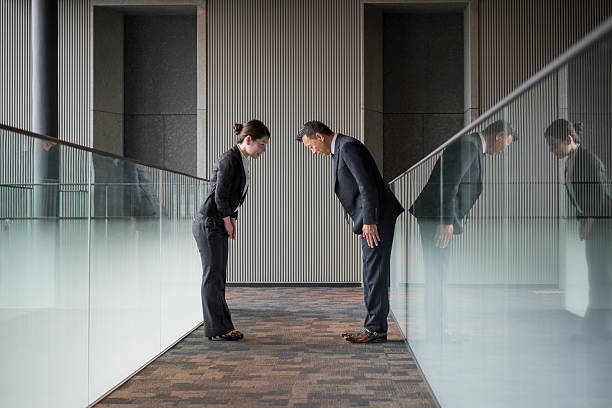
Source: https://www.istockphoto.com/photos/two-japanese-women-bowing-with-respect
Business Cards (Meishi)
Meishi (名刺) is the term for a business card, a fundamental part of Japanese etiquette. Exchanging meishi is not only about introducing yourself, but it is also about representing your organization in a formal ritual. There are key characteristics that make a meishi card stand out. The size of a card is about 91mm x 55mm. Typically, a thick cardstock-like paper is used. The information stated on the card includes: name, position, company name, company logo, department, and contact info. Typically, a phone number, website, email, and fax are also provided. A minimalist style is most commonly used, and the information will be written horizontally. During Meishi exchange, you will hold the card in both hands with the card oriented so the text is facing the recipient while performing a slight bow. When receiving a card, you will accept it with both hands and a nod. You should never immediately put the card in your pocket. Exchanging business cards in Japan is a formal and ritualized activity. Proper handling shows respect and professionalism.
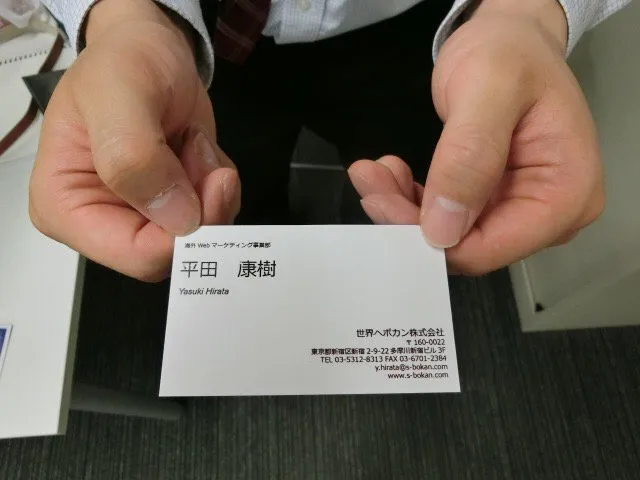
Source:https://ippoipposteps.com/2019/09/27/business-cards/